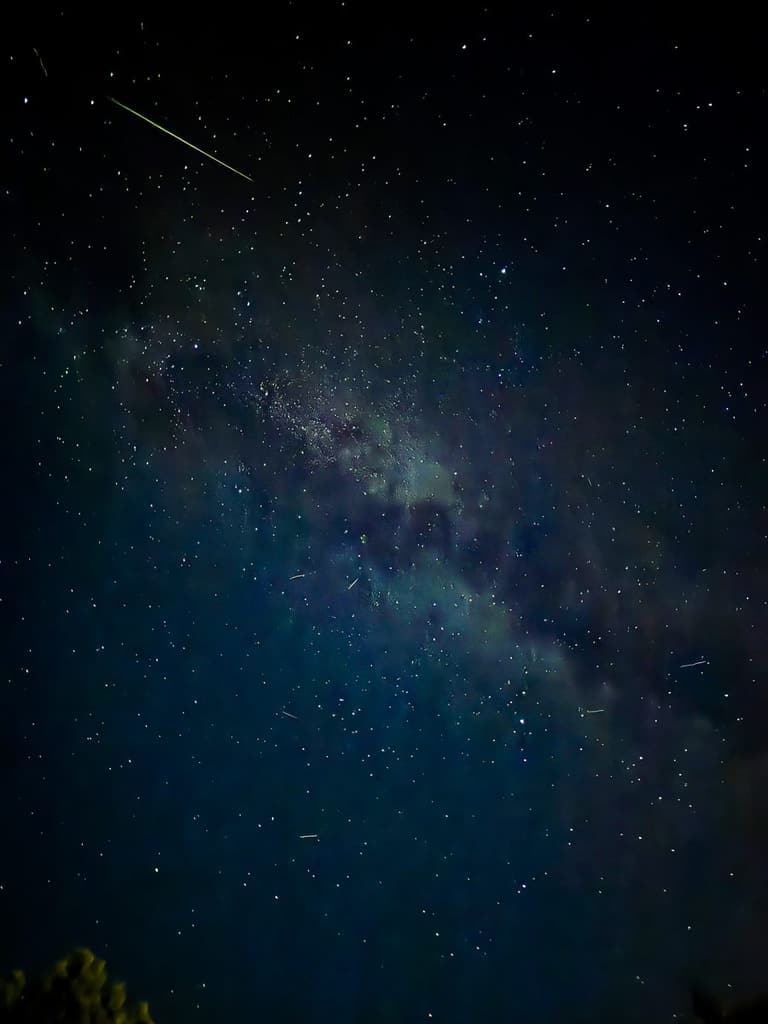
Peak night Aug 12–13, 2026 · new Moon (no moonlight) · nominal ZHR ~100/hr · fast (59 km/s) · radiant in Perseus.
The Perseids are the year's most-watched meteor shower, and 2026 had the one thing that matters most: the Moon was new on the night of the maximum, so no moonlight washed the sky out. From a genuinely dark site that meant a few dozen fast, bright meteors an hour — with the occasional fireball trailing a glowing train.
When it peaked in 2026
A meteor maximum is a window, not a minute. The International Meteor Organization's 2026 calendar puts the traditional broad maximum between 21:00 UTC on August 12 and 09:00 UTC on August 13, with the nodal maximum near 01:00 UTC on August 13 (±5 hours), plus a modelled brush with a branch of the 1079 dust trail near 16:53 UTC on August 12. The new Moon at 17:37 UTC on August 12 left both nights essentially moonless. As in every year, the Perseids were best in the dark hours after midnight, when the radiant has climbed high and your side of Earth turns into the debris stream.
| Your time zone | Broad maximum, local time | Best window to watch |
|---|---|---|
| US Pacific (PDT) | 2:00 PM Aug 12 – 2:00 AM Aug 13 | ~1:00–4:30 AM |
| US Mountain (MDT) | 3:00 PM Aug 12 – 3:00 AM Aug 13 | ~1:00–5:00 AM |
| US Central (CDT) | 4:00 PM Aug 12 – 4:00 AM Aug 13 | ~1:30–5:00 AM |
| US Eastern (EDT) | 5:00 PM Aug 12 – 5:00 AM Aug 13 | ~2:00–5:30 AM |
| UK (BST) | 10:00 PM Aug 12 – 10:00 AM Aug 13 | ~12:30–4:30 AM |
| Central Europe (CEST) | 11:00 PM Aug 12 – 11:00 AM Aug 13 | ~1:00–4:30 AM |
| India (IST) | 2:30 AM Aug 13 – 2:30 PM Aug 13 | after midnight–dawn |
| Australia East (AEST) | 7:00 AM Aug 13 – 7:00 PM Aug 13 | pre-dawn, radiant low |
Times are local clock time. The middle column is the IMO's traditional maximum converted to your zone — a twelve-hour plateau, not a spike — and much of it fell in daylight for the Americas and Europe. The right column is the part you could actually use: the radiant climbs all night and is highest just before dawn, and with no Moon the last dark hour before first light was the best of it. That made the pre-dawn hours of both Aug 12 and Aug 13 the two real chances.
Where to look
The meteors stream out of the constellation Perseus, which sits low in the northeast in the late evening and climbs through the night. Don't stare at the radiant, though — face a wide, dark, open patch of sky and take in as much of it as you can. Perseids can flash anywhere overhead.
Why 2026 was well placed
Most years the Moon is the Perseids' biggest spoiler — even a half-lit Moon drowns out the fainter meteors. In 2026 the Moon is new right at the peak, so the sky stays dark all night on both August 12 and 13. That made it one of the better-placed Perseid nights of the decade. It is worth being precise about what that does and does not mean: a dark sky removes the losses, it does not add meteors. The ~100 figure is a zenithal hourly rate — an idealised count for a flawless observer under a perfect sky with the radiant overhead — so a moonless night gets you closer to the stream's real output, not to the headline number.
What to bring
The Perseids are a naked-eye event — comfort matters more than optics.
- A reclining or zero-gravity chair — you'll be looking up for hours
- A red-light headlamp — preserves your night vision
- Warm layers and a blanket — even August nights get cool
- 10×50 binoculars (optional) — for the Milky Way between meteors
- Bug spray and a hot drink — small things, big difference
Frequently asked
When exactly did the Perseids peak in 2026?
Meteor maxima are windows, not minutes. The International Meteor Organization's 2026 calendar places the traditional broad maximum between 21:00 UTC on August 12 and 09:00 UTC on August 13, with the nodal maximum near 01:00 UTC on August 13 (give or take about five hours), and a modelled brush with a branch of the 1079 dust trail near 16:53 UTC on August 12. Popular listings quoted a single instant of 14 h 53 m UTC on August 13; treat that as one estimate inside a half-day-wide plateau rather than a guaranteed moment. Because much of that plateau fell in daylight for North America and Europe, the usable time to watch was the dark, pre-dawn hours of both August 12 and August 13.
Why was 2026 a good year for the Perseids?
The Moon was new on August 12, 2026 (exact at 17:37 UTC), so there was essentially no moonlight on either peak night — and moonlight is what usually spoils the Perseids. That removed the single biggest spoiler; it did not raise the number of meteors the stream itself delivered.
How many Perseids would you really see?
The headline ~100 an hour is the zenithal hourly rate: an idealised figure that assumes a perfectly dark sky, the radiant straight overhead and a flawless observer. Nobody sees it. From a real backyard with some light pollution, a good hour near the maximum is more like a few dozen. Pre-peak forecasts for 2026 also disagreed with each other by a wide margin, so treat any single predicted number — including the ~100 — as an upper bound rather than an expectation.
Do I need a telescope or binoculars?
No — they only narrow your view. The Perseids are a naked-eye event. Get away from city lights, let your eyes adapt to the dark for at least 20 minutes, lie back, and take in as much sky as you can.
Sources and review
- Meteor-shower timing and rates: IMO Meteor Shower Calendar — maxima are windows, not instants
- Cross-check on shower activity: American Meteor Society
- Moon phases and illumination: U.S. Naval Observatory
- Independent re-check of the windows and the new Moon: Astronomy Engine 2.1.19
Last reviewed by the Stargazr editorial team. Astronomical forecasts and meteor maxima are revised as primary sources publish; we update this page when they do. Found an error? corrections@stargazr.io