Every hobby has its jargon, and stargazing is no exception — magnitude, opposition, the ecliptic, ZHR. Here are the 57 terms you'll meet most often, each explained in a sentence or two, with a link on to the guide that goes deeper. Jump to a letter, or just browse.
A
- Altitude
- How high an object sits above the horizon, measured in degrees from 0° (right on the horizon) to 90° (straight overhead). → Reading a star chart
- Arcminute & arcsecond
- Units for small angles in the sky. One degree is 60 arcminutes, and one arcminute is 60 arcseconds — for scale, the full Moon is about 30 arcminutes across.
- Asterism
- A recognisable star pattern that isn't one of the 88 official constellations, such as the Big Dipper within Ursa Major. → Reading a star chart
- Aurora
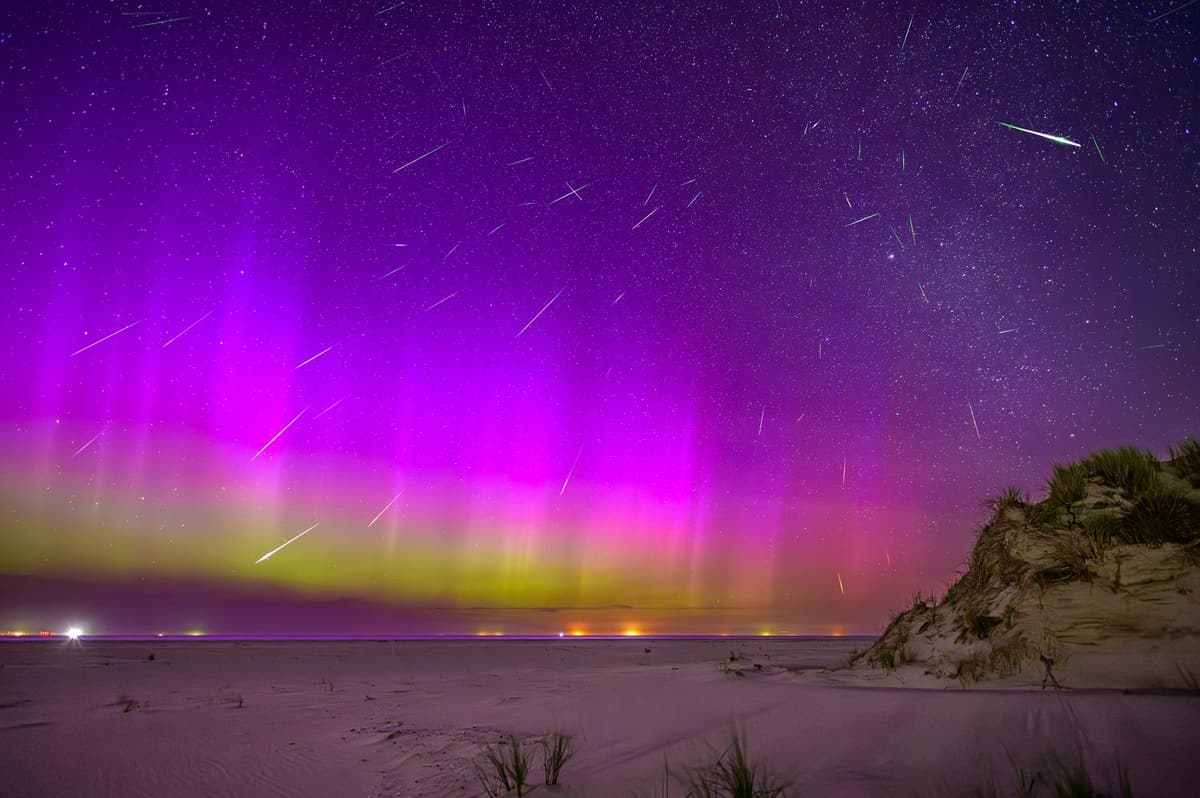
- The northern or southern lights — glowing curtains of colour caused by particles from the Sun striking the upper atmosphere near the poles. → Tonight's sky
- Averted vision
- The trick of looking slightly to one side of a faint object so its light falls on the more sensitive edges of your retina, making it easier to see.
- Azimuth
- The compass direction to an object, measured in degrees clockwise from north (0° = N, 90° = E, 180° = S, 270° = W). → Reading a star chart
B
- Bayer designation
- The system of labelling a constellation's stars with Greek letters, usually brightest first — Alpha, Beta, Gamma and so on. → Reading a star chart
- Blood moon
- A popular name for a totally (or deeply) eclipsed Moon, which turns a coppery red as it passes through Earth's shadow. → Lunar eclipses
C
- Celestial equator
- The imaginary line above Earth's own equator, ringing the sky exactly halfway between the two celestial poles. → Reading a star chart
- Celestial poles
- The two points the sky appears to rotate around through the night; the north one lies very close to Polaris. → Reading a star chart
- Circumpolar
- Describes a star close enough to the celestial pole that it never sets from your latitude, circling the pole all night instead. → Reading a star chart
- Conjunction
- When two objects — say the Moon and a planet, or two planets — appear close together in the sky as seen from Earth.
- Constellation
- One of the 88 official regions the sky is divided into, or the star pattern that gives the region its name. → Constellations
- Culmination
- The moment an object crosses the meridian and reaches its highest point in the sky — the best time to view it. → Reading a star chart
D
- Dark adaptation
- The 20–30 minutes your eyes take to grow sensitive in darkness. A single glance at a bright screen resets it, so use dim red light. → How to start stargazing
- Declination
- The sky's version of latitude: how many degrees an object lies north or south of the celestial equator. → Reading a star chart
- Deep-sky object
- Anything beyond the solar system that isn't a single star — galaxies, nebulae and star clusters.
- Double star
- Two stars that appear close together, either a true pair orbiting each other or a chance line-of-sight alignment.
E
- Ecliptic
- The Sun's apparent path across the sky over a year; the Moon and all the planets are always found close to it. → Reading a star chart
- Elongation
- The angle between a planet and the Sun in our sky. Greatest elongation is the best time to catch Mercury or Venus.
F
- Fireball
- An exceptionally bright meteor — brighter than the planet Venus. An especially brilliant one that explodes is called a bolide. → Meteor showers
G
- Galaxy
- A vast, gravitationally-bound system of billions of stars, plus gas and dust; our own is the Milky Way.
- Gibbous
- A phase of the Moon (or an inner planet) that is more than half but not fully lit.
L
- Light pollution
- Artificial skyglow from towns and cities that hides fainter stars, the Milky Way and meteors. The main reason a dark site shows so much more. → How to start stargazing
- Limiting magnitude
- The faintest magnitude you can see under the current conditions — a handy measure of how dark and clear your sky is.
- Lunar eclipse
- When the full Moon passes through Earth's shadow and darkens, often reddening. Completely safe to watch with the naked eye. → Lunar eclipses
M
- Magnitude
- The brightness scale for sky objects, running backwards so smaller (and negative) numbers are brighter: Sirius is −1.5, the faint naked-eye limit about +6. → Reading a star chart
- Meridian
- The imaginary line running from due north, up over the zenith, to due south. Objects are at their highest as they cross it. → Reading a star chart
- Messier object
- One of 110 bright deep-sky objects catalogued by Charles Messier — a classic first target list for binoculars and small telescopes.
- Meteor
- The streak of light — a “shooting star” — when a speck of space debris burns up in the atmosphere. The particle itself is a meteoroid; any piece that reaches the ground is a meteorite. → Meteor showers
- Meteor shower
- A spell when many meteors appear to stream from one point as Earth crosses the debris trail left by a comet or asteroid. → Best meteor showers 2026
- Milky Way
- The faint band of light arching across a truly dark sky — the combined glow of our own galaxy seen edge-on. → How to start stargazing
N
- Nadir
- The point directly beneath you, hidden by the Earth — the exact opposite of the zenith.
- Nebula
- A cloud of gas and dust in space — some glowing, some dark — and the birthplace of new stars.
- New moon
- The phase when the Moon sits between Earth and the Sun and its night side faces us, leaving the sky at its darkest — prime time for stargazing. → Best meteor showers 2026
O
- Occultation
- When one object passes in front of another, such as the Moon briefly hiding a star or a planet.
- Opposition
- When an outer planet sits opposite the Sun in our sky, rising at sunset and up all night — its closest, brightest showing of the year. → Planets
P
- Penumbra
- The lighter, outer part of a shadow. In a lunar eclipse the Moon only dims slightly while it is in Earth's penumbra. → Lunar eclipses
- Phase
- The changing sunlit fraction of the Moon (or an inner planet) that we see, cycling from new to full and back.
- Planisphere
- A rotating star wheel you dial to any date and time to show which stars are above your horizon at that moment. → Reading a star chart
- Polaris (the Pole Star)
- The moderately bright star sitting almost exactly above the north celestial pole, so it barely moves as the sky turns around it. → Ursa Minor
R
- Radiant
- The point in the sky a meteor shower's meteors appear to stream out from — it's what gives each shower its name. → Meteor showers
- Retrograde motion
- The temporary backwards (east-to-west) drift of a planet against the stars — an illusion created as Earth passes, or is passed by, that planet.
- Right ascension
- The sky's version of longitude, measured eastward around the celestial equator in hours rather than degrees. → Reading a star chart
S
- Seeing
- How steady the atmosphere is. Poor seeing makes stars twinkle hard and blurs fine detail in a telescope, however clear the sky.
- Solar eclipse
- When the new Moon passes in front of the Sun. Never look without proper solar filters — unlike a lunar eclipse, it is not safe for the naked eye. → The 2026 total solar eclipse
- Star cluster
- A group of stars born together — from loose, sparkling open clusters like the Pleiades to dense, ball-shaped globular clusters.
- Star-hopping
- Finding a faint target by stepping from bright, easy-to-spot stars along recognisable patterns until you reach it. → Reading a star chart
T
- Terminator
- The line between light and shadow on the Moon, where the low sun angle throws craters and mountains into sharp relief — the best place to look.
- Transit
- When a small body crosses the face of a larger one — a moon or its shadow crossing Jupiter, or Mercury crossing the Sun.
- Transparency
- How clear and haze-free the air is, which sets how faint the stars you can see. Separate from seeing, which is about steadiness.
- Twilight
- The graded darkening after sunset — civil, then nautical, then astronomical. True darkness begins only once astronomical twilight ends.
U
- Umbra
- The dark, inner part of a shadow. The Moon glows red when it enters Earth's umbra during a total lunar eclipse. → Lunar eclipses
W
- Waxing & waning
- Waxing means the lit part of the Moon is growing toward full; waning means it is shrinking back toward new. → Best meteor showers 2026
Z
- Zenith
- The point directly overhead — the very top of the dome of your sky. → Reading a star chart
- Zenithal hourly rate (ZHR)
- The ideal number of meteors an hour a shower would produce under a perfectly dark sky with its radiant overhead. Real backyard rates run lower. → Best meteor showers 2026
- Zodiac
- The band of constellations lying along the ecliptic, through which the Sun, Moon and planets appear to move. → Reading a star chart
New to all this? Our beginner's guide to stargazing shows how to start tonight, and how to read a star chart puts many of these terms to work.
Explore
How to start stargazing · Read a star chart · Constellations · Meteor showers · Planets · Lunar eclipses · Live sky map