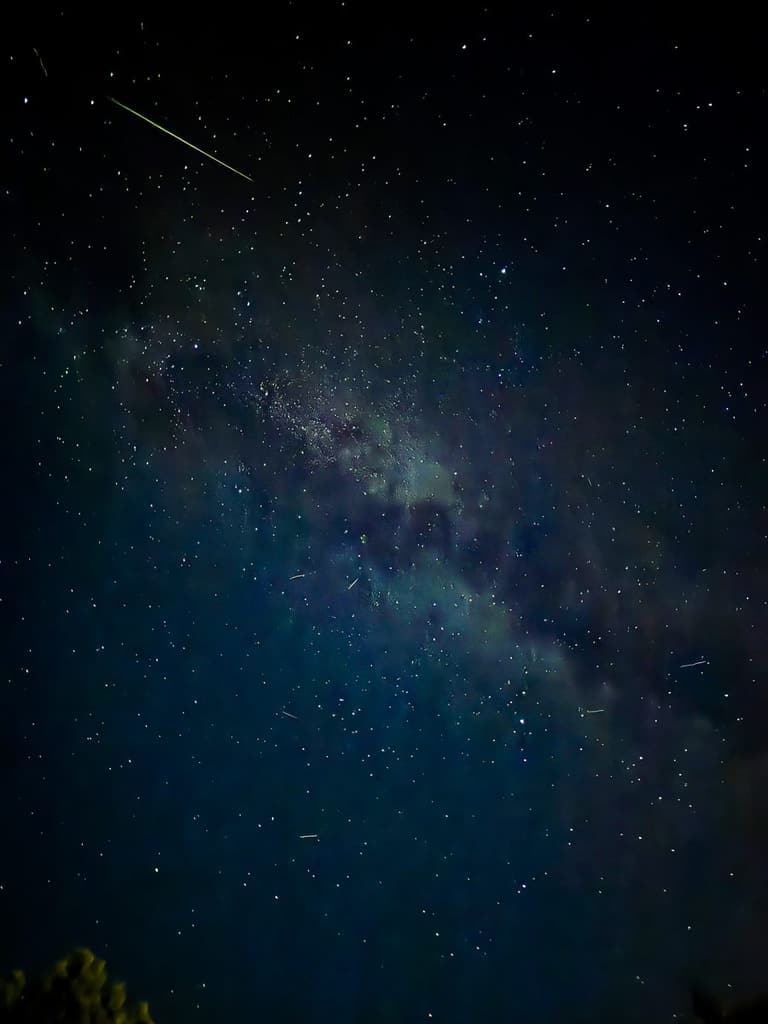
There are nine major meteor showers each year, but they're far from equal — and the single biggest factor in any given year is the Moon. A rich shower under a full Moon can be a letdown, while a modest one under a dark sky quietly delivers. Below, every 2026 shower is rated by its real peak-night conditions: its ideal rate weighed against exactly how much the Moon interferes. Two nights rise clearly above the rest.
The two to plan around in 2026
The richest shower of the year — slow, bright, often multicoloured meteors, up to ~150 an hour. In 2026 only a thin crescent Moon lingers in the early evening and sets well before the prime after-midnight hours, so the sky is dark when it counts. Visible from both hemispheres. If you watch one shower all year, make it this one.
See the Geminids 2026 guide →The famous, warm-night summer shower. 2026 was well placed: the maximum landed on a new Moon, leaving the sky dark all night. Fast, frequent meteors with the occasional bright fireball; the quoted ~100 an hour is an idealised zenithal rate, not a count to expect.
See the Perseids 2026 guide →Every 2026 shower, night by night
The full calendar, in order through the year. Tap any shower for its full guide, or the "2026 guide" link for the dated night-by-night forecast where we've published one.
| Shower | Peak (2026) | Max/hr | Moon on peak night | Worth it in 2026? |
|---|---|---|---|---|
| Quadrantids | January 3 | ~110 | full Moon (~100%) | Poor in 2026 — Moon washes it out |
| Lyrids | April 22 | ~18 | waxing crescent (~26%) | Good — some moonlight |
| Eta Aquariids | May 6 | ~50 | waning gibbous (~81%) | Poor in 2026 — Moon washes it out |
| Southern Delta Aquariids 2026 guide → | July 30 | ~25 | full Moon (~99%) | Poor in 2026 — Moon washes it out |
| Perseids 2026 guide → | August 12 | ~100 | new Moon (~1%) | Excellent |
| Orionids 2026 guide → | October 21 | ~20 | waxing gibbous (~75%) | Poor in 2026 — Moon washes it out |
| Leonids 2026 guide → | November 17 | ~15 | first-quarter Moon (~49%) | Good — some moonlight |
| Geminids 2026 guide → | December 14 | ~150 | waxing crescent (~24%) | Excellent |
| Ursids 2026 guide → | December 22 | ~10 | waxing gibbous (~96%) | Poor in 2026 — Moon washes it out |
"Max/hr" is the ideal zenithal hourly rate under a perfectly dark sky with the radiant overhead — real backyard rates run lower. The verdict weighs that rate against how much the Moon is up on the 2026 peak night: a bright Moon drowns out the fainter meteors, so a rich shower can still be a poor year.
How to watch — the short version
You don't need any gear. Pick the darkest spot you can reach on a clear night near the peak, get comfortable, and give your eyes 20–30 minutes to adapt to the dark (no phone). Face a wide, open patch of sky rather than the radiant itself, and be patient — the best rates almost always come in the dark hours after midnight. New to this? Start with our beginner's guide to stargazing.
Frequently asked
What are the best meteor showers to see in 2026?
Two stand out because the Moon cooperates: the Geminids (night of December 13–14, up to ~150 meteors an hour under only a thin, early-setting crescent Moon) and the Perseids (night of August 12–13, up to ~100 an hour on a new Moon). Both peak in dark skies in 2026, which is what separates a great shower from a washed-out one.
Why are the Geminids ranked ahead of the Perseids in 2026?
The Geminids are simply the richer shower — up to ~150 meteors an hour versus the Perseids' ~100 — and in 2026 both peak in a dark sky (a new Moon for the Perseids, a thin crescent that sets early for the Geminids). With the Moon out of the way for both, the Geminids' higher rate and its bright, colourful, slow meteors put it narrowly on top.
Which 2026 meteor showers does the Moon spoil?
In 2026 a bright Moon washes out the Quadrantids, Eta Aquariids, Southern Delta Aquariids, Orionids and Ursids on their peak nights — the Moon is up for much of the night and hides all but the brightest meteors. Those showers are far better in a year when their peak falls near a new Moon.
Do I need a telescope to watch a meteor shower?
No — meteor showers are a naked-eye event, and binoculars or a telescope only narrow your view. Get away from city lights, dress warmly, let your eyes adapt to the dark for at least 20 minutes, lie back, and take in as much of the sky as you can.
Explore
All meteor-shower guides · Planets · Lunar eclipses · Constellations · Tonight's sky →